
Clinical Training to Assess Patients for ADHD
-
Proficiency Level: Expert
This course is for medical professionals assessing patients for ADHD in a clinical setting and explores how to successfully use assessment tools and interpret the data of screening and assessment, forming a diagnosis within the NICE guidance framework and the role of non-medical and medicines management in ADHD.
Our Courses are Only Suitable for Medical Professionals
Please click here to see the qualifying list below for eligibility to take our courses
- Clinicians
- Doctors
- General Practitioners
- Prescribing Pharmacists
- Band 7 Prescribing Nurses
- Band 7 Nurses in Mental Health
- Band 7 Advanced Practice Nurses
- Band 6 (top) with experience, working towards Band 7 (Advanced Practice)
This course is for medical professionals assessing patients for ADHD in a clinical setting and explores how to successfully use assessment tools and interpret the data of screening and assessment, forming a diagnosis within the NICE guidance framework and the role of non-medical and medicines management in ADHD. Meeting the standards required in writing a diagnostic report and onward referrals and supporting the needs of patient’s post-assessment. There is a final exam, and this course contributes to your continuing professional development portfolio.
What you'll learn
- ADHD explanation, differences
- Screening Practices
- Diagnostic Tools and criteria
- Identification and core symptons
- Risk Assessment
- NICE guidelines
- Differential Diagnosis
- Medication and Non Medical options
- Report writing
- 8 Sections
- 87 Lessons
- Lifetime
- Module One - Anatomy of the brainIn this module, we look more closely at the anatomy of the brain and learn what is happening in the brain of a patient with ADHD. We will look at the natural development of the brain from birth to seven years and why the age of seven is such an important milestone in brain development. We explore the DSM-5, ICD-10 diagnostic criteria and NICE Guidance NG87. We review the standards we must meet to be an assessor to diagnose, treat and care for patients of all ages, with ADHD13
- 1.1Module 1 – Overview1 Minute
- 1.2Exploring early brain development6 Minutes
- 1.3Early brain development in neurodiversity4 Minutes
- 1.4Module 1 mini quiz – Understanding cognitive development in children over the age of seven5 Minutes5 Questions
- 1.5Early brain development in neurodiversity – post mini exam1 Minute
- 1.6The actions of neurons in the brain4 Minutes
- 1.7The vital balance of dopamine regulation in the brain3 Minutes
- 1.8Dopamine regulation in ADHD vs non-ADHD individuals2 Minutes
- 1.9Implications of dopamine dysregulation in ADHD5 Minutes
- 1.10The DSM-5 criteria for diagnosis in ADHD5 Minutes
- 1.11ICD-10 criteria for diagnosis in ADHD6 Minutes
- 1.12NICE guidance NG875 Minutes
- 1.13Module 1 final10 Minutes15 Questions
- Module Two - Lifelong diagnosis of ADHDIn this module we explore the process of screening patients for ADHD both prior to referral and during the diagnostic process. We review the screening tools used once you have accepted the patient referral. We look at how the tools best align with the diagnostic criteria and when to choose the right tool and how to use it.12
- 2.1Module 2 – Working Towards a Diagnosis2 Minutes
- 2.2The screening process2 Minutes
- 2.3The Adult ASRS-v 1.1 Screener5 Minutes
- 2.4Conners Adult ADHD Rating Scales (CAARS)5 Minutes
- 2.5Wender Utah Rating Scale (WURS)2 Minutes
- 2.6Qb-Test2 Minutes
- 2.7SNAP-IV as a child screening tool3 Minutes
- 2.8Consolidate Your Learning5 Minutes
- 2.9The introduction of subtypes in ADHD5 Minutes
- 2.10Understanding diagnostic subtypes in ADHD5 Minutes
- 2.11Consolidate your learning – Module 23 Minutes
- 2.12Module 2 Quiz5 Minutes7 Questions
- Module Three - Screening patientsIn this module we look at the impact a lifelong diagnosis in ADHD can have on an individuals mental wellbeing. The impact on children across the ages and how symptoms may present differently in adolescents and adults.12
- 3.1Module 3 – Overview – Screening Patients1 Minute
- 3.2The impact of ADHD across the ages3 Minutes
- 3.3Case studies – Paul2 Minutes
- 3.4Case studies – Scott2 Minutes
- 3.5Case studies – Meena2 Minutes
- 3.6Case studies – Adrienne2 Minutes
- 3.7Case studies – Summary2 Minutes
- 3.8The individualised symptoms of ADHD5 Minutes
- 3.9Emotional and psychological impact5 Minutes
- 3.10Help for adults post-diagnosis3 Minutes
- 3.11Help for children post-diagnosis2 Minutes
- 3.12Module 3 mini quiz4 Minutes5 Questions
- Module Four - Child screeningIn this module we look at a child case-study screening and the steps involved in assessing their developmental history and family health history. We look more closely at safeguarding and the complex relationships between children of ADHD parents and why this is an important factor in safeguarding.15
- 4.1Module 4 – Overview1 Minute
- 4.2Child case-study: Peter Fleet10 Minutes
- 4.3Developmental History5 Minutes
- 4.4Risk assessment and mental state examination
- 4.5Safeguarding adults and children
- 4.6Informative studies on ADHD parenting
- 4.7The latest research in the multifaceted relationship between parental ADHD symptoms
- 4.8Improving outcomes for families with ADHD
- 4.9Comorbidity in parental ADHD
- 4.10Risk assessment in children with ADHD
- 4.11Peter Fleet – SNAP-IV assessment outcome
- 4.12Red flags in ADHD assessment – children
- 4.13Red flags in ADHD assessment – adults
- 4.14Key Points for practitioners
- 4.15Module 4 Quiz10 Minutes5 Questions
- Module Five - NICE guidanceIn this module we explore NICE Guidance NG87 on the recognition, referral, diagnosis and treatment of ADHD. We look specifically at the tools used in the assessment process and choosing the right tools and screening tools for both adults and children. We review the typical journey for a patient with ADHD from referral to diagnosis.8
- 5.1Module 5 – Overview
- 5.2NICE Guidance on ADHD Assessment
- 5.3Choosing the right tools
- 5.4The typical journey to a diagnosis
- 5.5NICE Guidance summary on Cardiac Patient Care in ADHD
- 5.6Patients with a history or actively involved in substance misuse
- 5.7NICE Guidance on differential diagnosis
- 5.8Module 5 Quiz30 Minutes15 Questions
- Module Six - Differential diagnosisIn this module we explore less common presentations that may mimic ADHD. Understanding differential diagnosis is key to assessing ADHD and many differential diagnosis have patterns or presentations that will set them apart from ADHD.16
- 6.1Module 6 – Overview
- 6.2Comorbidity and Differential Diagnosis
- 6.3Sensory Processing Disorder (SPD)
- 6.4ADHD and Comorbidity
- 6.5Pathological Demand Avoidance (PDA)
- 6.6Module 6 Mini Quiz10 Minutes5 Questions
- 6.7Module 6 – Mini Quiz – Follow On
- 6.8Case Study – (A)
- 6.9Case Study – (B)
- 6.10Case Study – (C)
- 6.11Case Study – (D)
- 6.12Case Study – (A) – Review
- 6.13Case Study – (B) – Review
- 6.14Case Study – (C) – Review
- 6.15Case Study – (D) – Review
- 6.16Review of differential diagnosis – core features
- Module Seven - MedicationIn this module we learn about classes of medication, stimulants versus non-stimulants and the prescribing considerations assessors need to be aware of for special populations. Contraindications in prescribing and managing side effects. The monitoring and follow up needed to keep patients safe and how to successfully manage side effects. There are three patient case studies to consider.13
- 7.1Module 7 – Overview
- 7.2Classes of Medication
- 7.3Contraindications and prescribing
- 7.4Managing Side Effects in Medication
- 7.5Case Study One – Child with ADHD and Poor Appetite
- 7.6Case Study Two – Adult with Substance Misuse History
- 7.7Case Study Three – 15 Year Old Male – Cardiac History
- 7.8Case Study – Key Take Aways
- 7.9Child medication study (a)
- 7.10Child Medication Study (b)
- 7.11Child Medication Study (c)
- 7.12Medications – Key Learning Points
- 7.13Module 7 Quiz10 Minutes5 Questions
- Module Eight - Clinical reportsIn this final module we look at the content of a good clinical report. Delivering a lifelong diagnosis and answering patient questions. We review the flow from referral to end report, in the diagnostic journey. We consider the waiting period, non-medical treatment options and the introduction of self-help strategies for newly diagnosed patients. A final exam revisits the course content, and a course certificate is generated on successful completion of the course.7
The materials library is only available for students.
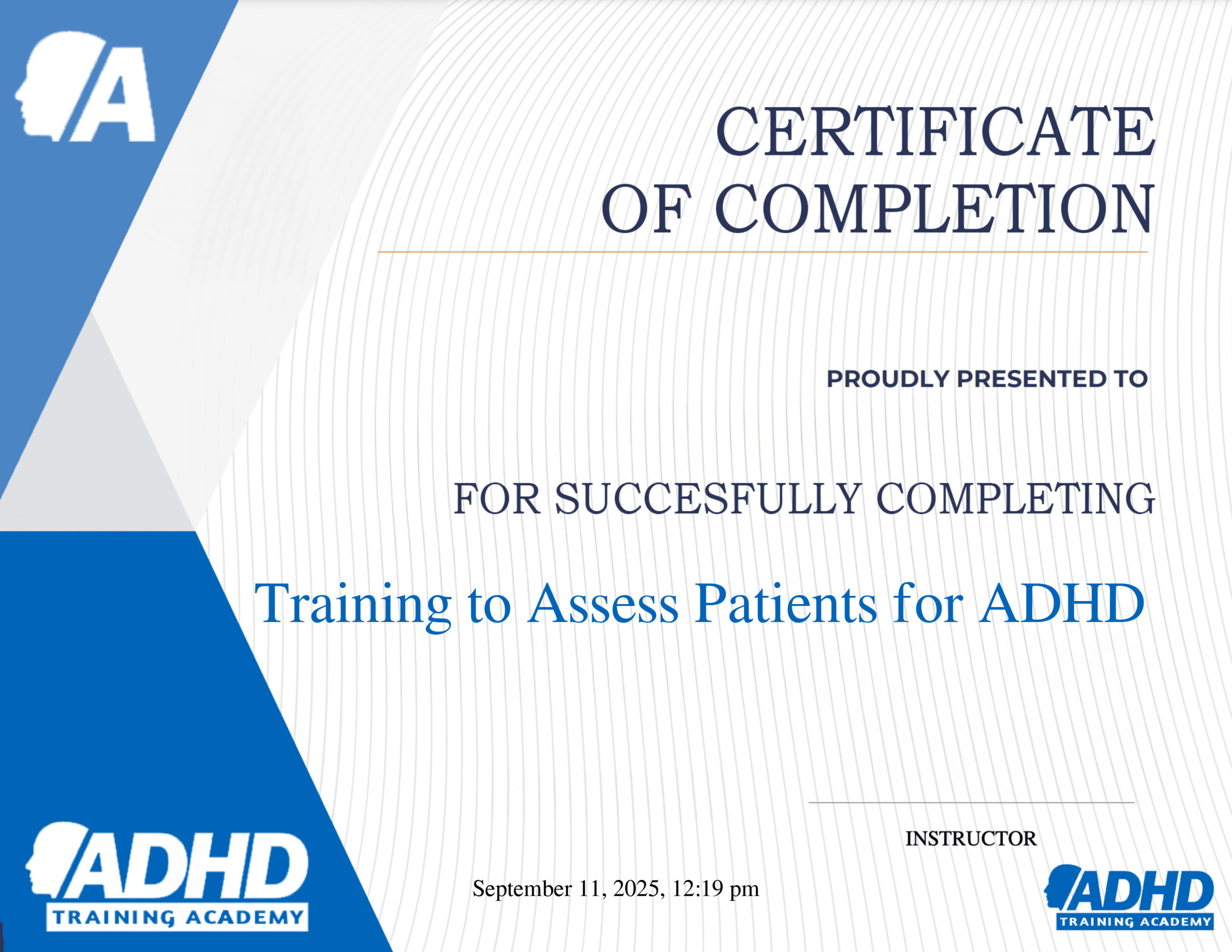
Sample Certificate
- User-Friendly Interface
- Mentorship available
- Materials library
- Mobile APP coming soon
- Laptop, desktop, tablet or mobile device
- Dedication
- A willingness to learn
- Completion of Challenge Statement
This course is for medical professionals assessing patients for ADHD in a clinical setting and explores how to successfully use assessment tools and interpret the data of screening and assessment, forming a diagnosis within the NICE guidance framework and the role of non-medical and medicines management in ADHD. Meeting the standards required in writing a diagnostic report and onward referrals and supporting the needs of patient’s post-assessment. There is a final exam, and this course contributes to your continuing professional development portfolio.
What you'll learn
- ADHD explanation, differences
- Screening Practices
- Diagnostic Tools and criteria
- Identification and core symptons
- Risk Assessment
- NICE guidelines
- Differential Diagnosis
- Medication and Non Medical options
- Report writing
Sample Certificate
You might be interested in
Transform your career with our Assessor's Course


CPD Clinical Course provider for NHS staff and private providers of ADHD services for patient assessment from age 7+